A Social Justice Newsletter For Educators
“Anti-racist work means acknowledging that racist beliefs and structures are pervasive in all aspects of our lives—from education to housing to climate change—and then actively doing work to tear down those beliefs and structures. Those beliefs and structures don’t just exist in primarily white/and or privileged institutions—they thrive there.” – Christina Torres, “All Students Need Anti-racism Education”
Greetings, everyone!
Thank you, subscribers, for your kind responses to this ongoing effort. In a few weeks Bending The Arc will celebrate its first anniversary. And wow, what a year this has been!

At my school in Austria we’ll have the privilege of being able to begin the school year in person with all of our students and colleagues in the building. There will be some things that we’ll need to do a little differently and under the circumstances we’re aware that every plan is contingent. Over the summer I’ve been thinking a lot about our privilege as I converse with colleagues in the US and other parts of the world. Given our fortunate position in Austria, what are some things we can do to take up the work of justice right now? That question has been needling me all summer and while I’m never entirely satisfied with the response, the point is that the question persists and I keep responding as best I can.
Considering Abolition
Building on the momentum created by the Black Lives Matter protests across the US and beyond, a number of thinkers have offered visions of what society could look like without mass incarceration and predictable police brutality. One conversation among 3 Black women educators and a Black male curator of the Schomburg Center in NYC stands out for me as inspired and generative thinking about abolition in the context of education.
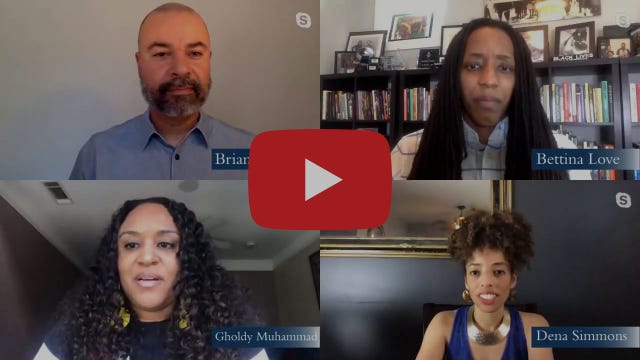
Listen to Bettina Love, Gholdy Muhammad, Dena Simmons in conversation with Brian Jones on anti-racist and abolitionist teaching and learning.
I have a special place in my heart for this conversation and part of it is the joy of just hearing Black folks talk and listen with each other. Watching it the second time it dawned on my how rarely I experience this kind of encounter in my media consumption.
I encourage us all to do more reading up on abolition. In this opinion piece, “Yes, We Mean Literally Abolish The Police”, Mariame Kaba, a seasoned activist for prison and police abolition, asks us to imagine creating the conditions for a more just society. She writes:
“People like me who want to abolish prisons and police, however, have a vision of a different society, built on cooperation instead of individualism, on mutual aid instead of self-preservation. What would the country look like if it had billions of extra dollars to spend on housing, food and education for all?”
When we dream with students about what their and our ideal worlds might look like, I think many of these ideas are present. I also recommend this two-part podcast with abolitionist Ruth Wilson Gilmore which offers more context for the current movement and also because she’s a fascinating person to hear!
A few more things before I go:
A wonderful piece of student writing on identity and belonging which would make a lovely mentor text for HS writers: “What’s In The Wok” by Ysa Quiballo
Thinking about all the openings ahead, I did a short thread on ice breakers and thoughtful facilitation which several found helpful.
For the folks at my school I created a special newsletter on anti-racism in international education in July. There’s a lot going on!
The opening quote is from an essential read on why all students need anti-racist education. Particularly for those of us teaching in predominantly white and privileged settings, I find this an excellent point of departure.
I know this is waaaayyy more than you actually have time for, especially at the start of the year (or mid-year southern hemisphere). The good news is that there are no poor choices! Perhaps try just one thing and save the rest for later.
Be well and take care,
Sherri
 Bending The Arc
Leave a comment