A Social Justice Newsletter for Educators
Mimesis
By Fady Joudah
My daughter
wouldn’t hurt a spider
That had nested
Between her bicycle handles
For two weeks
She waited
Until it left of its own accord
If you tear down the web I said
It will simply know
This isn’t a place to call home
And you’d get to go biking
She said that’s how others
Become refugees isn’t it?
Copyright Credit: Fady Joudah, “Mimesis” from Alight. Copyright © 2013 by Fady Joudah.
Source: Alight (Copper Canyon Press, 2013) and The Poetry Foundation
Let the poets speak
When I struggle to find the words, what often materializes on the pages of my journals can look like poems. The words assemble themselves to sound as if they could be a poem. It doesn’t really matter if they so identify or not. Above all, these fragments become an escape valve of feeling and thought which lead me closer to what I’m hoping to say.
It’s early October, the US election is less than a month away. Across the EU, far right and openly fascist groupings are winning elections. The destruction of Gaza continues. The suffering of millions in Sudan barely receives mention in Western media. Dramatic natural disasters that leave devastation in their wake have become seasonal norms. These are the topics that are coursing through my mind these days. So much of the news that reaches me is dispiriting. Resisting both despair and inaction becomes a mighty challenge.
This is why poetry matters. Poetry is where I turn when I feel overwhelmed. Often fewer words on the page, there’s the relief of space between ideas or images, even if those words hold the power of a cathedral bell ringing at noon. Poems encourage me to pause and reread. What did I just hear? How did that catch me? Poems are humanity sprinklers. For me, an unexpected line or an image can provide the answer when I enter a text and ask, “what did I come in here for?”
Here’s a small sampling of poems that are speaking to me these days:
“We Lived Happily during the War” by Ilya Kaminsky – please listen to Pádraig Ó Tuama read and discuss this remarkable poem which is probably the main inspiration for this section of the newsletter. It feels a bit like cheating to share a piece of the poem, but these are the lines that will not let me go:
“In the sixth month
of a disastrous reign in the house of moneyin the street of money in the city of money in the country
of money,
our great country of money, we (forgive us)lived happily during the war.”
“Schtzngrmm” by Ernst Jandl – This video includes war footage as a backdrop to the Austrian poet reading his “Lautgedicht,” poem of sounds, which is based on the term Schutzengraben – trenches. Also, I am a die hard Ernst Jandl fan.
“Self Care” by Solmaz Sharif – read and discussed by Pádraig Ó Tuama on Poetry Unbound. A series of questions that ask us to question what we consider, “self care” to be and entail.
“Have you removed
your metal fillings? Made peace
with your mother? With all
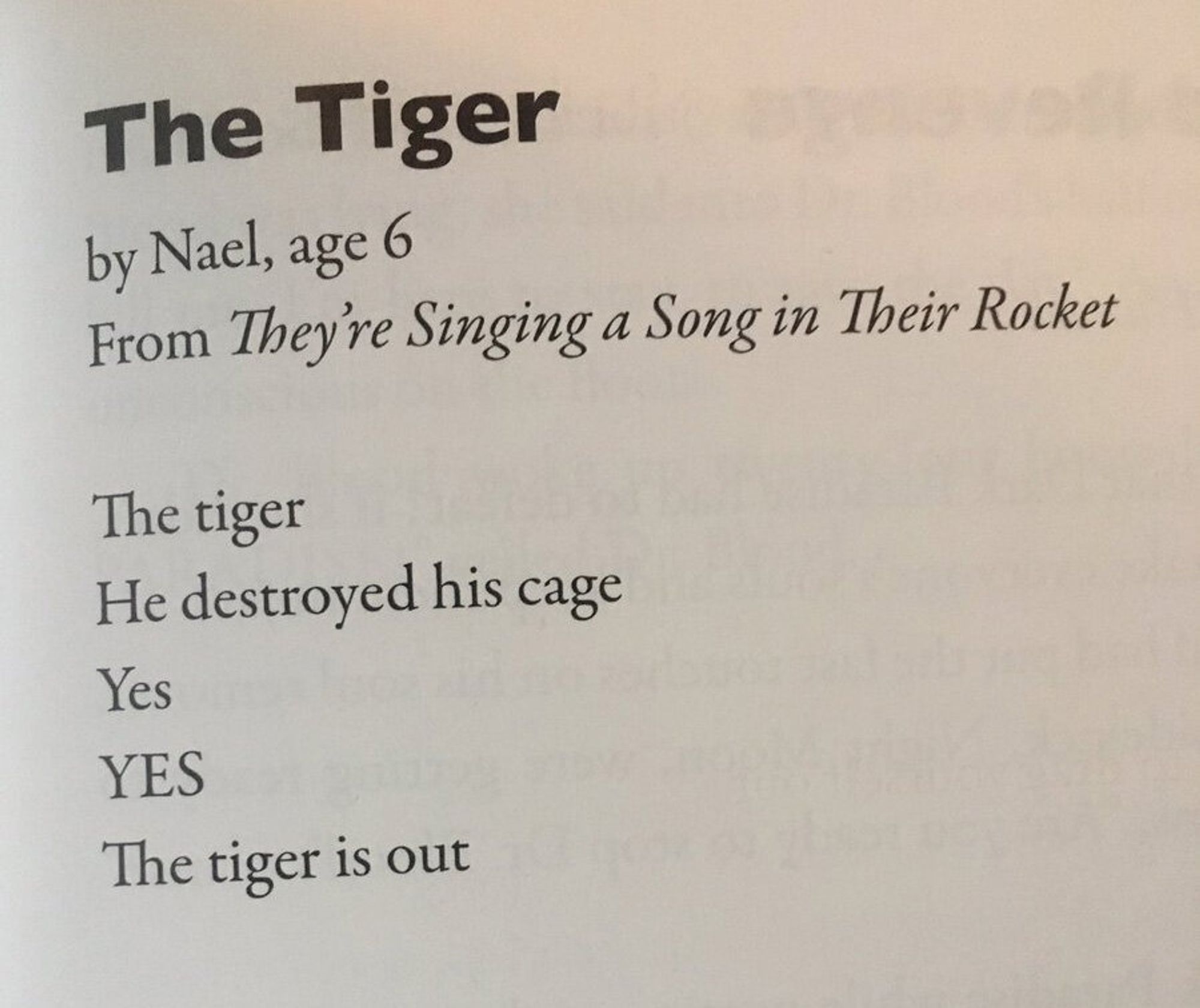
the mothers you can?”“The Tiger” by Nael, age 6 – this poem has crossed my social media path often and I am always grateful when it appears. It reminds me of the amazing poets who walk among us in our classrooms, gyms and theaters.
Also consider visiting the Teach Living Poets website for excellent resources designed for secondary classrooms. In particular I want to draw your attention to their digital library of living poets as a breathtakingly generous share.
Nael’s viral poem is part of a collection of work produced by students in an after school program in Washington, DC. You Will Be Able To Say A Thousand Words is available here.
Some thoughts on belonging
As the backlash to Diversity, Equity, Inclusion and Justice (DEIJ) has built muscle and force, over the last 4 years in particular, individuals and institutions have been rethinking the use of those terms which have come under fire. One of the words that institutions and DEI industry insiders have landed upon as a seemingly uncontroversial alternative is belonging. In this process, the terms most likely to be jettisoned have been justice (“unattainable, unrealistic”) and equity (“Isn’t inclusion, enough?”).
I don’t have big answers here. I am observing trends. While I try not to become too attached to naming conventions, it’s impossible not to notice the actions that have accompanied shifts in vocabulary: DEI programs, both corporate and in other domains, being cut and sidelined. Anti-DEIJ legislation in myriad forms, specifically targeting LGBTQ identities but also preventing programming and funding in the US, for example, continue to crop up. Stoking fear has become incredibly lucrative and attention-grabbing.
Given that, I think it’s worth considering an understanding of belonging offered by the Othering and Belonging Institute at UC Berkley:
“The concept of belonging describes more than a feeling of inclusion or welcome. Its full power is as a strategic framework for addressing ongoing structural and systemic othering, made visible, for example, in the wide disparities in outcomes found across a variety of sectors and identity groups.
Belonging, as OBI defines it, means having a meaningful voice and the opportunity to participate in the design of political, social, and cultural structures that shape one’s life — the right to both contribute and make demands upon society and political institutions. At its core, structural belonging holds a radically inclusive vision because it requires mutual power, access, and opportunity among all groups and individuals within a shared container (such as a society, organization, club, etc).”
Allow me to highlight:
“a strategic framework for addressing ongoing structural and systemic othering”
“the right to both contribute and make demands upon society and political institutions”
“mutual power, access, and opportunity among all groups and individuals within a shared container”
So when Belonging is mentioned and applied in your context, feel free to ask if this is what folks have in mind. What I mean is that whatever we call the efforts to create schools, departments, offices that are in fact more just and fair to all, the harder task will always be to define where power is located and who has access and opportunity to use or share that power. If our move towards belonging does not include an explicit consideration of power, then window dressing the status quo is quite likely what’s happening. (Consider Megan Pillow and Roxane Gay’s Do The Work as a helpful resource in sharpening your understanding of power.)

Things to be on the lookout for
Ta-Nehisi Coates’ latest book, The Message, is out now. I have yet to read it but the conversation around his reflection on visiting Israel and Palestine in May 2023 has convinced me that the book will be required reading for me this year. To get a feel for what’s in store, listen to/watch this interview:
The Association of International Educators and Leaders of Color (AIELOC) along with Women of Color in English Language Training (WOC in ELT) are hosting their annual virtual conference on November 3rd, 2024. You can register HERE.
Alright, friends, that’s it for now.
I really thought this month’s newsletter would be different. Poetry was not on my October bingo card; yet here it is, sauntering right up to the mic, grabbing us by the lapels, commanding our attention.
I hope you are thriving wherever you are in your calendar and season. Let’s be gentle with ourselves, our students and our colleagues. Find a poem on a page, a screen, in your pocket, on your headphones, in the air, under a streetlamp. Pause. Breathe. Continue.
Be well,
Sherri

 Bending The Arc
Leave a comment