
Back in the saddle!
Well, the carousel has turned a few more times and many of us find ourselves back in our starting positions, prepared to embark on the next ride of a school year. How do you feel about that? What’s your vibe going into another academic cycle? What are you excited about? Which things would you rather put off considering?
When we reconvene in our respective learning communities following a long break we can experience a wide range of emotions. Even if we know what to expect (catch-up banter, meetings, and more meetings), there’s still plenty of room for unanticipated feelings to enter the chat. Something I notice as I age: despite decades of routine, my anxieties at the outset seem to echo more loudly than in previous years. While matters typically turn out fine, I begin the school year with a level of trepidation that might surprise some of my colleagues if they knew.
Not sure why that it is, or where it comes from but I dare to acknowledge it. In some ways it speaks to the current state of the world bearing countless sources of uncertainty and injustice. We remain witnesses to an ongoing genocide, the collapse of a democracy-oriented superpower, and a surge in xenophobic and illiberal political movements across the West. It’s a lot and not easy to escape. We thought we’d be in the clear after the pandemic but in reality the pandemic never ended. We thought that the war in Ukraine wouldn’t last very long. We thought that surely the international community would step up to prevent the mass starvation and continued bombing of Gaza. We thought that the US government structures of checks and balances would protect us from a lawless executive branch. We’ve been proven wrong on multiple accounts in short order.
Given all that, how we show up to welcome a new school year will vary. Our energies will vary. I hope we can keep that in mind as we reconstitute our organizations for a fresh run. Let’s design for everyone’s participation, not only the extroverts’. Let’s create spaces for connection before content. Let’s acknowledge multiple realities and “move at the speed of trust.” (Emergent Strategy, adrienne maree brown)
Thanks for coming to my TED Talk.

Alas, gen AI again.
This month I have put together some resources for thinking about generative AI or Large Language Models (LLMs). To be clear, I am not a fan. It’s a suite of tech tools I have no interest in using. Gen AI represents ideologies I find detrimental to human flourishing. It is built on stolen labor. Its proliferation exacts an enormous environmental toll that will impact generations. I see it as my obligation to stay informed about all of these aspects and remain engaged in the conversation and encourage resistance.
Start Here.
The Civics of Technology website offers an absolutely stellar selection of resources for both classroom use and professional development. More importantly, the work represents the collaborative energies of educators across disciplines, levels and nationalities who want to serve the wider community of learners by curating, developing and sharing materials that address both concerns and enthusiasms around all forms of tech applied in education.
Many of the resources that follow are inspired by or from that website! (I would love to say more about that choice but for now, just know there’s also a message in this approach.)
- Books worth considering:
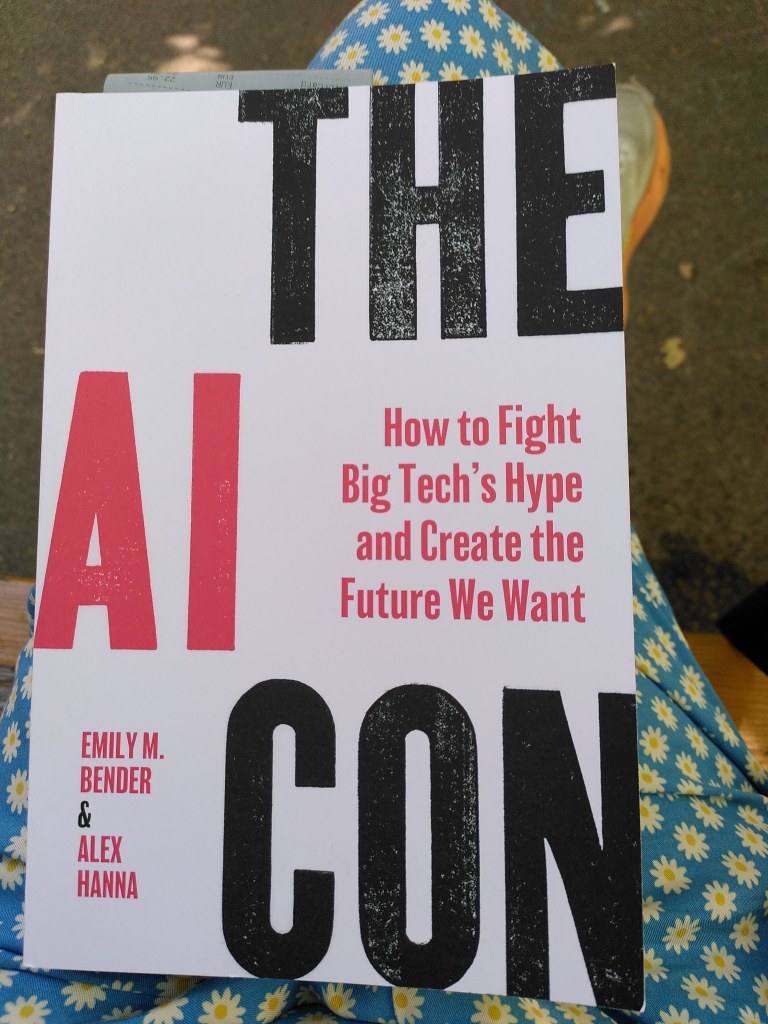
The AI Con (2025) by Emily M. Bender and Alex Hanna. One of the best reads of the summer. Accessible, thoughtful, well reasoned, The AI Con illustrates how industry hype is used to introduce products based on their promises rather than their actual capabilities. Also includes proposals for resistance.
On an individual level, sometimes methods of everyday resistance work the best. As a consumer, you have the option to simply not use AI tools. Don’t use ChatGPT. Don’t use Midjourney. When your new favorite app offers a new, flashy AI-enabled tool, just don’t click it. (p.171)
The Empire of AI (2025) by Karen Hao examines the narrative arc of gen AI proliferation and likens the process to empire building. A conversation between Karen Hao and journalist Carole Callawalldr (unfortunately hosted on Substack) offers an excellent intro to the book’s premise and arguments.
- Listen to teachers:
High school English teacher, Chanea Bond writes compellingly about banning the use of gen AI in her classes.
“While some teachers say that AI can serve as a brainstorming partner or an outline generator, I believe it’s so important for students to learn these skills themselves. I’m extremely concerned that reliance on AI will hinder those who need the most support, ultimately putting a Band-Aid over their education rather than addressing the root issues.” – Chanea Bond.
A blog post I find painfully relevant asks: “Are we setting teachers up to take the fall for future AI risks that institutions haven’t properly flushed out, weaponizing teachers’ desire for professional autonomy and agency against them?” 🤔 🔥
“The focus on teachers as the main guardrail to protect our students and society from the negative effects of AI is too much.” – Jessa Henderson
Anne Lutz Fernandez, one of the most prolific educator-authors I know, teases out the tensions between systems embracing gen AI tools in schools and the consequences for students, teachers and society in general. She has compiled a compelling set of arguments against the use of gen AI in schools which is both well researched and articulated.
- Broader perspectives
I also encourage folks to read these succinct remarks by Alondra Nelson delivered to an assembly of world leaders countering three fallacies about generative AI. Here are the cliff notes (not an AI summary):
- “The purpose of AI is not scale or efficiency. The purpose of AI is people.”
- We say AI requires tradeoffs, sacrificing one thing to achieve another. That’s a false binary. Rather, AI requires thoughtful governance.
- “It is not inevitable that AI will lead to great public benefits” therefore AI development and regulation require the participation of those whom it will directly impact.
The whole speech is around 3 minutes long and I find it a beautifully crafted message that goes hard without beating listeners over the head.
Finally, Meredith Whittaker, who is the president of the Signal Foundation, was asked in 2023:
“What’s one underrated big idea?
We need to recognize the current paradigm of large scale artificial intelligence as a product of concentrated power in the tech industry, and we need to trace that history back to the moves that were made in the 1990s where unfettered surveillance became the engine of the tech industry’s business model. That enabled the creation of a handful of large firms that now have the resources necessary to produce artificial intelligence, those capital-intensive resources being computational power and data.“
*sigh*
I know, I know. Who has the time? You need to set up your classroom, manage the duty schedule, make sure all the orders have arrived at their correct destinations. I’m with you. Save all this for later. Have a look over the weekend or send it on to your retired friends who have more time to read.
If and how you make use of generative AI in your life, one question I ask all of us to consider is this:
What are your boundaries around using this technology?
Once you have answered that for yourself, you may have occasion to wonder about where your line(s) in the sand might be. Or where those boundaries came from, by applying which lens? Staying curious is key. And bear in mind, the tool is secondary to the ideology that supports it. Think about the use and power (economic, political, cultural) at the same time. Whose power increases as this technology is used to mediate the majority of our informational interactions? The industry is betting on the notion that consumers are not willing/able/prepared to make these connections. As educators, this should be our cue.
Palate cleanser (sort of):
Let’s go!
Friends, I hope you’ll forgive me if this all seems a little preachy. This month’s newsletter is brought to you by local and global anxiety in the face of rising fascism. Sure, I would rather chat about lighter, more upbeat topics but I also want to address one of the elephants in the room right off the bat. Above all, I hope we keep talking about gen AI as a manufactured priority and what that means for us in this historical moment.
In contrast, when we gather, let’s celebrate being humans together. Let’s laugh and hug, snack and chat. Let’s put our devices down for a moment and relish the buzz of anticipation. On those first few days, let’s remember who we most want to be to and with each other. And for the days that follow, let’s try our best to live out those visions.
Thanks for continuing to support this project. It means a lot.
All the best,
Sherri
P.S. Thank you to everyone who read and responded to my last message encouraging you to donate to the Nancy Drew documentary project. Great news! Cathleen and her team reached their stretch goal of $95,000 which will get them much closer to the production finish line following the sudden loss of their NEH grant funding!


 Bending The Arc
Leave a comment