
“If the elongated text made by AI, or the images of forests or people, or the music it writes does not hold much emotional meaning for you, you might eventually learn to set expectations of emotional responses aside. After all, emotion isn’t all that helpful to passing a class or getting a job.
Human literacy is quite helpful, though, because living a life consciously — with real connection to interpreting and creating the poetic for whatever it is that life sets in front of us — is a far more important skill for life satisfaction than slotting words correctly for a chatbot.”
– Eryk Salvaggio in “Human Literacy“
It’s been a minute.
I’m learning to ditch the apologies if the newsletter does not come out when I think it should. I know that it will happen when there’s time and space and that’s enough. I’m also learning to allow for new or different approaches to sharing what’s up and out there. Given where we are in the month, where we are in the acceleration of fascist movements in the West, where we are in the intensifying of violence on the majority of continents, I think I’ll keep it brief this time around. (Ha!)
Most people I know currently have “a lot going on.” Even as I recently got to celebrate my older son’s wedding (so lovely!) and spend time with siblings and friends for the occasion, I found myself hustling on both ends to manage the rest of life in progress. Joyful in the midst of occupied. Delighted on the way to distracted.
After 5 full weeks of school, my schedule almost memorized, student names firmly anchored in my mind (until they’re not), I would love to say that I’ve hit my stride. Instead it feels more like lurching from event to event. Whether its fashioning my goals for the year or deciding which PD paths I might take, there’s a quality of breathlessness that I would prefer not to participate in. I have not yet figured out a way to resist the tug of productivity culture that permeates not only our professional environments but also our leisure pursuits.
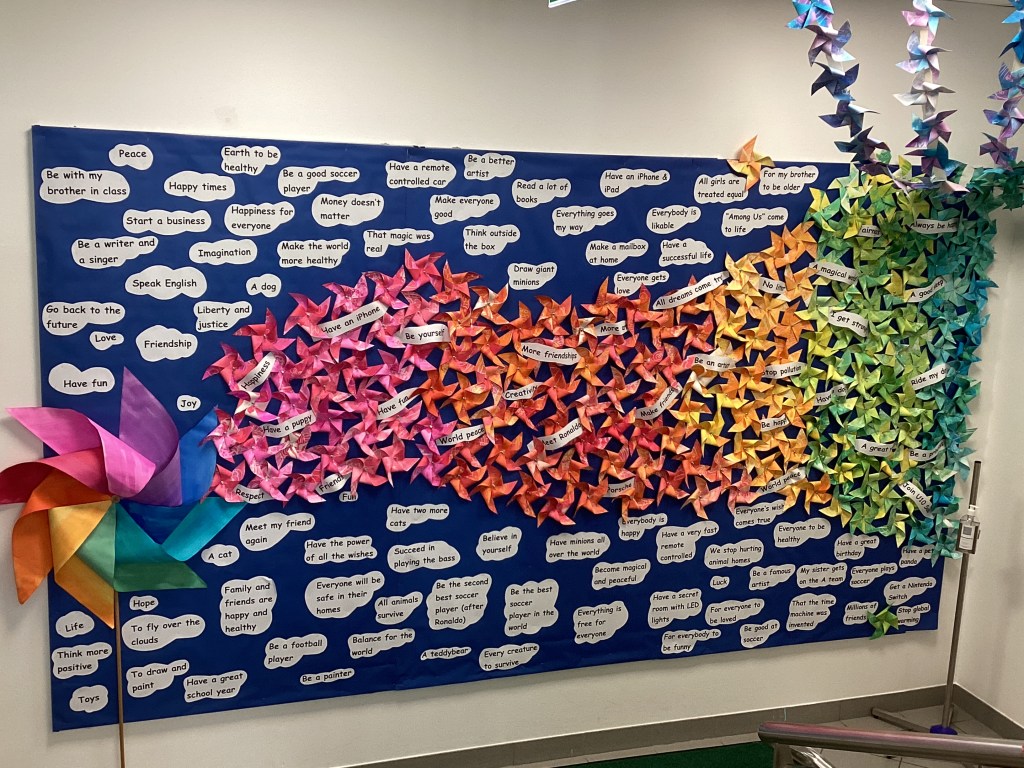
All of which serve as reminders that agency is a muscle we need to exercise in contexts where resistance abounds. We need to practice acknowledging and choosing differently. We can get creative with zooming out and sometimes even zoning out. It’s worth attempting to slow down on occasion. We can choose community and build towards all kinds of solidarity, even in the smallest forms. Like my colleagues organizing a morning bike ride to campus with a shared breakfast before school. Or, students dropping in to talk to members of the belonging team during lunch. Like second graders racing into the gym in anticipation of Awesome Gym Day. Witness the beautiful pinwheel display full of children’s wishes: “to have minions all over the world” next to “a puppy” next to “Everyone will be safe in their homes.” When we look around, even in the swirl of institutional activity, there are always moments of connection, of pause, of agency. Let’s notice those and take a breath.
Staying On Message
I’m going to continue to beat my gen AI resistance drum. This time with some thoughts from the student perspective.
- “At My School No One Is Talking About AI” by Sam Barber
“I think that if our teachers could actually talk to us about AI and explain why it’s valuable to do the assignments on your own, we could avoid some of the risks using AI creates. I also want teachers to know that if we could exert more agency over what assignments we were doing, we might all be more interested in what we’re doing and care more about learning.”
- “I’m a High School Student. AI is Demolishing My Education” by Ashanty Rosario
“I am concerned about what will happen as the short-term solutions presented by chatbots become the only ones that people know how to pursue—especially beyond the classroom. If we keep leaning on AI to sidestep pressure or deadlines, what happens when the tools aren’t there?”
Preach, Ashanty!
I must include one more essay because it is beautiful and soulful and kind. Eryk Salvaggio, who is not a HS student but a researcher of AI systems and their cultural impacts, makes the case for centering human literacy in a way that is at once poetic and practical.
“I should say again, though, that human literacy is a part of AI literacy. Can you use AI to tell your own story? You can, but the human literacy has to be there. You are better off knowing what the AI cannot do for you if you want to understand how to get something out of it. You could invest inward, into knowing what your voice is for and how you want to use it, before you allow it to be contorted to the language of the universal poetry machine.”
Forgive me, friends, if I linger too long on this theme for you. If I insist on reiterating my position on generative AI. I am trying to make sense of the world my children and grandchildren(?) are inheriting/will inherit. There is so much change I want to see in the world but generative AI – the promotion of energy draining data centers to power the tech, the application of AI systems to defraud and harm people at scale – are not it. So I continue to bang this particular drum.
One more student essay I would like to offer tells a different story, yet relates to our society’s hankering for perfection. Sharlyn Barrett describes her path away from submitting to “The Degrading Scale” *:
“ Humans aren’t meant to chase perfection; we’re meant to practice, learn, and grow. No child should feel that the only acceptable existence is a flawless one.
Is a student really learning if they start at the top and never improve? A class without scales can make space for discussion, connection, and real growth. Students can focus on proving things to themselves, not others.”
* This essay is from the Grow Beyond Grades Community writing contest. Might be of particular interest to secondary students.
Bearing Bad News
Meanwhile, our news channels and social media feeds are overflowing with graphic violence and reports from numerous conflict areas. Our kids live in the same world and are managing a fire hose of content and messaging that threaten to overwhelm them. As a reminder about how to talk to our children (of all ages) about violence and war, I offer this useful guide from UNICEF. Among the key suggestions: Find out what they know and feel; spread compassion, not stigma; and continue checking in.
Listening to our young people should be our first commitment. With that in mind, I invite you to take in some of these poems for peace from children around the world. I particularly appreciated Kadidia’s delivery of this poem about Mali:
At the outset, I thought I would be brief. Thought I could keep the word count down, the links to a minimum. And look at what happened! As always there’s too much left to say, so many more stories to share.
I hope your September is going as smoothly as it possibly can, that your patience is blooming as generously as needed.
Stay safe, friends.
Sherri
 Bending The Arc
Leave a comment